Search for a comparison of two professional peels and you will find a great deal of writing about what each one does. Very little of it comes from anyone who has to stand behind it. This piece takes the opposite approach: it compares the two products on everything a buyer can verify, and is straightforward about the one question it will not answer.
The question this article does not answer
We are not going to tell you which peel produces a better result, or which is right for a particular patient. Not because we are being coy, but because it would be the wrong thing for a supplier to do. That decision belongs to the practitioner holding the clinical responsibility, made against the manufacturer’s instructions for use, the individual in front of them, and their own training and indemnity. A wholesaler’s blog is not a clinical reference, and treating it as one is how people end up in difficulty.
What a supplier can tell you usefully is what arrives, how much of it, what it costs per unit, how it has to be stored, and how long it lasts. That is genuinely the part most comparisons skip, and it is the part that decides whether a product works for your clinic as a business.
What each product is
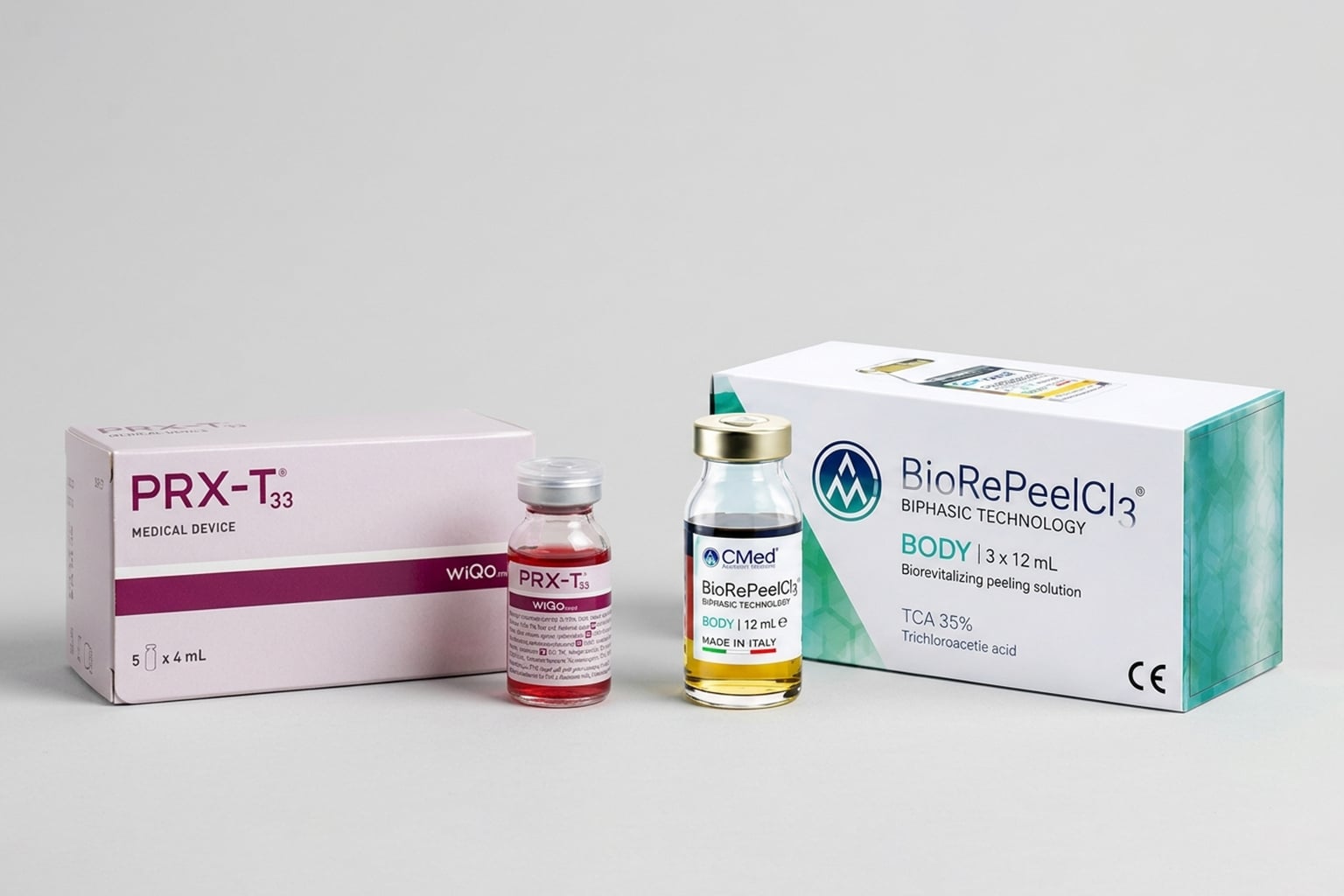
Both PRX-T33 and BioRePeel are professional-use products supplied to practitioners, and both are supplied in multi-vial presentations rather than as single-use units. Their compositions are stated by their respective manufacturers and are printed on the packaging and in the instructions for use.
These are deliberately left for verification rather than written from memory. Composition is the one thing in an article like this that must be exactly right, and the only acceptable source is the current documentation for the presentation actually being sold — formulations and pack contents change between markets and between revisions
Presentations and what they mean for cost
This is where the two differ in a way that is entirely verifiable and rarely discussed.
- PRX-T33 is stocked here as a 5 × 4ml presentation.
- BioRePeel is stocked in more than one presentation, including a CL3 Body format supplied as 3 × 12ml vials, alongside the CL3 FND presentation.
The practical consequence is that the two products are bought in quite different quantities, so a headline price comparison between them tells you almost nothing. Work in cost per millilitre, or better, cost per treatment at your own usage — and then check that against how quickly you would get through the pack, because a lower unit cost on a pack you cannot finish before its expiry is not a lower cost at all That is the same arithmetic as our guide to buying short-dated stock, and it applies just as much to full-priced multi-vial packs.
Storage,shelf life and part-used packs
Multi-vial presentations raise a question single-use products do not: what happens to the rest of the pack after the first vial is opened. The answer is specified by the manufacturer for each product and is not something to reason about from first principles.
Two practical points that hold regardless of which you choose. Record the date a pack is first opened, on the carton, in pen — nobody remembers. And store the pack where its stated conditions are actually met rather than approximately met, which in most clinics means not the shelf above a steriliser and not the door of a fridge that is opened forty times a day.
What to ask a supplier
Whichever you are ordering, the same five questions will tell you most of what you need:
- What presentation is it, exactly — how many vials and what volume in each?
- What is the expiry on the stock you would actually be sending me?
- What are the stated storage conditions, and how does it ship?
- What does the manufacturer say about a part-used pack?
- Can you supply the current instructions for use for this presentation?
A supplier who cannot answer the fifth question is a supplier to think twice about. The IFU is not optional paperwork; it is the document that governs how the product is meant to be handled, and it should arrive with the product or be available on request without a discussion.
Both are stocked
Aesthetics Warehouse carries PRX-T33 in the 5 × 4ml presentation and the BioRePeel range including the CL3 Body 3 × 12ml format, with current presentations, prices and stock status on the product pages. Where a line appears on the short-dated stock page, the expiry is shown against it.
If you are choosing between them for clinical reasons, speak to your trainer or the manufacturer. If you are choosing between them for supply reasons — pack size, cost per treatment, how fast you get through a pack — the numbers above are the ones to work with.